
Collaboration between MAPI, UDELAR, and MIDES
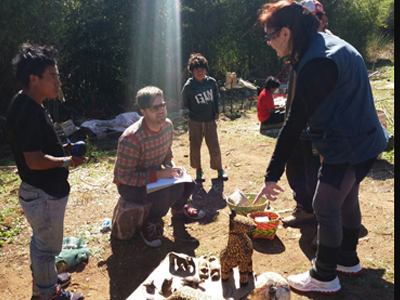
Last Saturday, a team from the MAPI – Museum of Pre-Columbian and Indigenous Art and from the School of Humanities and Education Sciences of the Universidad de la República—made up of the museum’s director, Facundo de Almeida; the archaeologist Carmen Curbelo (FHUCE/CUT/UDELAR); the archaeologist Luis Bergatta, coordinator of exhibitions at the MAPI; and Lic. Belén Cantera, a MIDES technical officer for the Cerro Largo region—traveled to the Department of Cerro Largo to meet with the Indigenous group belonging to the Mbyá-Guaraní people settled in Aceguá.
The objective was to learn about their particular situation, and their situation in relation to the rest of society, and to offer, from our fields of knowledge, our mediation in any circumstance that might place them in a vulnerable position because of their different cultural practices.
This family belonging to the Mbyá-Guaraní people has been settled for several weeks on a plot of land near the border line of this town in Cerro Largo, where there is a cane field that provides them with the raw material to make baskets of various colors and sizes, a craft production they complement with wood carvings representing various native animals.
The group represents a teko´a, that is, a group of people united by kinship ties under the authority of a cacique.
The team was able to confirm that the group is organized, with its basic needs covered, working intensively on the craft production they sell to neighbors and visitors of the town who come to the site. They are also planning their next steps, which include, in the coming months, settling on a rural property in the area, whose owner has agreed with them on the planting of various crops, including corn (avachi in the Mbyá-Guaraní language), which is sown in September–October.
The visit was coordinated by the MAPI and UDELAR with the MIDES Deputy Minister for Social Development, Prof. Ana Olivera, and the MIDES Regional Coordinator in Cerro Largo, Aida Silveira, who together with her team has been assisting this Mbya-Guaraní group in a context respectful of their idiosyncrasy, one that allows them to continue developing their traditional cultural practices.
The MAPI also acquired a set of crafts—baskets and wood carvings—of great beauty and quality, which will be offered for sale in its Shop, making it possible for visitors to the Montevideo museum to discover and buy original Indigenous craftwork. The money raised will go toward future purchases of the crafts made by this and other Mbya-Guaraní groups present in the country.
Among the pieces acquired by the MAPI are: ajaka guachu (large basket), ajakaí (small basket), chivi (jaguar), karumbe (turtle), kaguare (anteater), and urukure’a (owl).
About the Mbya-Guaraní community in Aceguá, Cerro Largo:
The presence of this Mbyá-Guaraní family is not something foreign or exceptional for Uruguay if we bear in mind—as the social anthropologist Analía Pérez Landa explains—that “The Mbya Guaraní are an age-old ethnic group of the region, located in Argentina, Paraguay, and Brazil, with one of the largest Indigenous populations concentrated in the latter country. Their presence in Uruguay also goes back a long way. The Mbya-Guaraní are groups that were present in these territories before colonization, so their existence predates the formation of the countries as we know them.
In fact, one of the characteristics of this population is migration across these territories, made up of the present-day countries mentioned above. Their migration responds to a religious-communitarian conception, driven by the search for new spaces in which to create and maintain their way of life, centered on preserving the Ñande–reko, “our common way of being”.
Broadly speaking, in terms of their cultural characteristics, the Mbya Guaraní live in villages (teko´a) or communities. Within them there is no distinction between economic and family strategies; everything runs through community life—health, education, care, religion. As for leadership, there is the cacique or karaí, who provides political and spiritual guidance. Moving through different territories is a decision guided by him, and it serves a specific purpose—religious, political, and identity-related.
They conceive of the territory encompassing these four countries as a broad network of ancestries, histories, and memories that unite their people in a web of belonging. Uruguay is part of their conception of territory, of their memory and lived experience.
The Mbya-Guaraní, like the other Indigenous groups of the Americas, see themselves as a group outside the Nation-States, since their culture responds to other political-communitarian orders, different from those our society conceives”.
In our country, considered and constructed by historiography as a “country without Indians”, this way of relating to territory represents a challenge to its categories of thought and to its knowledge of its own history and of the Indigenous groups that have occupied its current political territory for thousands of years. This forced invisibility of the Indigenous means that, when this absence becomes presence, mistaken ideas and statements are triggered—such as considering them “indigent” people—as well as counterproductive actions such as institutionalizing them, sending them into the school system, and so on.
The anthropologist Pérez Landa adds that “these communities are part of the cultural diversity of the region, and as diversity they call for respect. Dialogue and help are indeed necessary, provided they proceed from the understanding that we are dealing with different conceptions of the world, and that not everything comes down to a single way of seeing things”.
Those who wish to learn more about the reality of the Mbya-Guaraní groups or to purchase their craftwork can do so at the MAPI, located at 25 de Mayo 279, between Colón and Pérez Castellano, in Montevideo.