
Lecture: Candace Greene
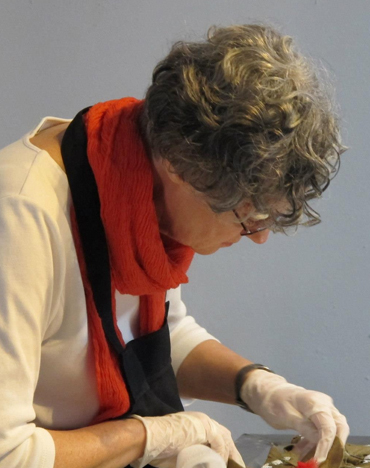
The Smithsonian Institution ethnographer Candace Greene, Ph.D., gave the lecture “One Hundred Summers: Reading a Kiowa Calendar” in the Salón Azul Dr. Aquiles Lanza of the Intendencia de Montevideo.
The lecture, which featured simultaneous interpretation, was organized by the Embassy of the United States of America in Montevideo and the MAPI – Museum of Pre-Columbian and Indigenous Art, and addressed the Native American cultures that underwent numerous changes between the 19th and 20th centuries.
In the lecture, Greene explored some of these changes and discussed the use of museum collections for researching this history. The talk focused on one example in particular: a pictorial calendar, or winter count, a unique chronicle of the history of the Kiowa tribe, drawn by the artist Silver Horn.
Dr. Candace Greene explained how she deciphered the meaning of this history, preserved only in pictures, which spans one hundred years of Kiowa history, from 1828 to 1928. These tiny pictures provide us with an Indigenous perspective on events ranging from horse raids into Mexico to service in World War I, looking at Kiowa life from buffalo hunts to car accidents.
Candace Greene (PhD ’85) is an anthropologist at the Smithsonian Institution’s National Museum of Natural History, and the author of “One Hundred Summers: A Kiowa Calendar Record” (2009), “The Year the Stars Fell: Lakota Winter Counts at the Smithsonian” (2007), and “Silver Horn: Master Illustrator of the Kiowas” (2001).