
Love
With the participation of: Antonio Augusto Bueno, Andrea Finkelstein, Mauricio Guridi, Gustavo Martínez, Marcos Medina, Rosina Peluffo, and Emilia Rovira.
In the form of a triptych, like Giacomo Puccini’s Il trittico, Dante Alighieri’s Divine Comedy, or The Garden of Earthly Delights by the Dutch painter Jheronimus Bosch (El Bosco), the exhibition is conceived in three acts and unfolds in the three galleries on the second floor of MAPI. While they could coincide with the Christian idea of heaven, purgatory, and hell, they consist of the presentation of a free idea about the history of what we now call the American continent. A story about the time before the arrival of the Europeans, the conquest and the resistance up to the present day, and the relationship between this continent and the other continents and their cultures.
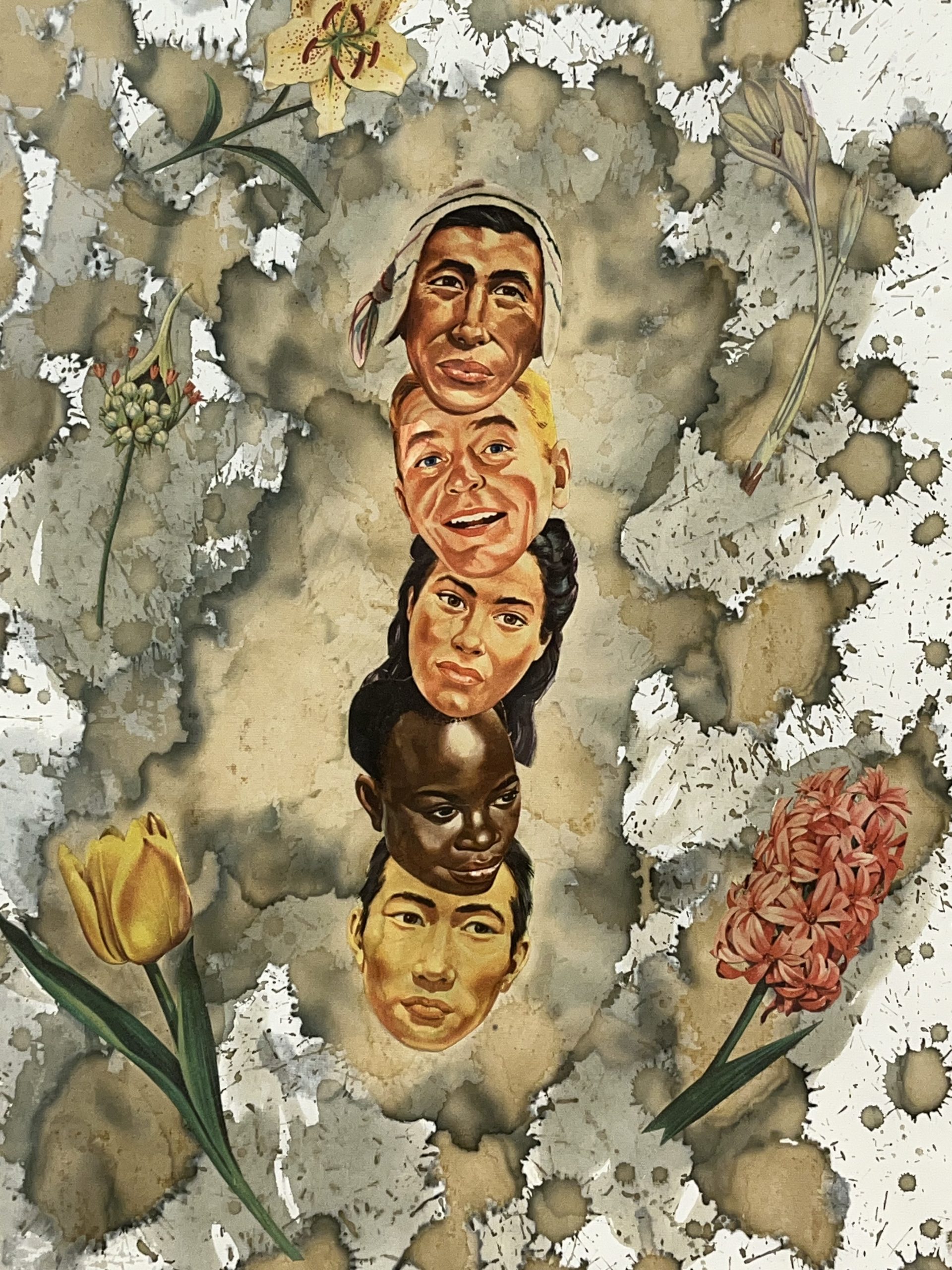
In its three galleries, Tabares investigates different aspects that have to do with the regional. The first reflects on the history, use, and customs of yerba mate, from the Guarani tradition, the Jesuit missions, and the regional gaucho world to what we have inherited from those cultures. “I have approached it from different angles, and one of them is the aesthetic. I have carried out various experiments with mate water, using it as ink for painting and drawing.
A second gallery presents prints, objects, and sculptures from the Yvy Mara`y series, a Guarani concept related to the Land Without Evil, a kind of Guarani mirror of the Jewish Promised Land and of a better world.
The third gallery is a sensory, participatory installation presenting several series of artist’s books, sculptures, and collages of what I call “This, While It Is History.” They are a compilation of thousands of images that dialogue with one another, generating new texts that aim to build a narrative out of personal concerns based on investigating and revealing contradictions in the concept of civilization.”
The articulation of these narratives centers on representation and on the tensions produced within consumer society, in the art system, in collections and archives, in matters of heritage and identity, in memory, in addictions, in popular beliefs and religions, in the culture of sex, pornography, and taxonomy. A kind of epistemological anthropophagy that results in a sort of vomit through which his appropriations can be glimpsed, resulting in political pieces from a decolonizing perspective, as a need to challenge the poetic and the aesthetic in order to distort politics.