
Traveling exhibition opens in Saint Petersburg
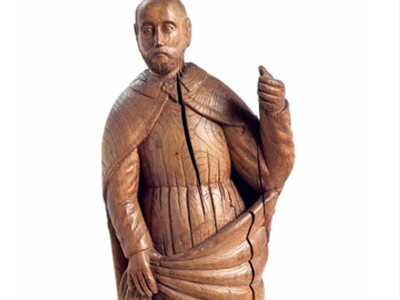
The traveling international exhibition “Uruguay in Guaraní. Missionary Indigenous Presence” will open on February 3 at the Russian Museum of Ethnography in Saint Petersburg, as part of an extensive tour that began in 2014 at the Vatican Museums and continued through museums in Hamburg, Valencia, and Alicante.
The exhibition, produced by the MAPI—which operates under the Department of Culture of the Intendencia de Montevideo—in partnership with the National Meat Institute (INAC), as part of the strategic alliance between the two institutions, and with the support of the Ministry of Foreign Affairs, brings together archaeological objects from museums, institutions, and private collections in different parts of the country, with the aim of revealing Uruguay’s little-known Guaraní heritage and the fact that what is now its territory once belonged to the system of Jesuit Missions.
The exhibition, which has already been visited by more than 600,000 people in Europe, features religious images carved in wood in the 17th and 18th centuries, as well as archaeological objects from the 19th century found at the San Borja de Yi site, all the result of research coordinated for more than 20 years by the archaeologist Carmen Curbelo of the School of Humanities of the Universidad de la República, with the participation of numerous researchers and archaeology students. The exhibition’s commissioner is the director of the MAPI, Facundo de Almeida, and it was curated by Luis Bergatta.
The museographic script reflects the main Indigenous heritage in Uruguay, that is, the legacy of the Guaraní presence in the country’s present-day territory, not only through historical and archaeological materials but also through intangible cultural expressions that are highly representative of the country’s image: its place names—the very name Uruguay is of Guaraní origin; the consumption of the country’s main beverage, mate; and the beginnings of the development of livestock production—the Jesuit ranches were its main antecedent—among other elements of identity.
This last theme is presented as a historical continuum that ranges from the relationship of Indigenous groups with meat products and the incipient livestock production on the ranches of the Society of Jesus to the contemporary traceability system, addressing issues such as production, innovation, tastes, cultural representations, and heritage in Uruguay. This last aspect is represented by the Fray Bentos Industrial Landscape, better known as the former Anglo meatpacking plant, which was declared a World Heritage Site by UNESCO as a material expression of the cultural importance that livestock production had, and still has, in the country.
The exhibition has the support of the Ministry of Tourism, the Ministry of Education and Culture, the School of Humanities and Education Sciences, the Universidad de la República, the Intendencia de Montevideo, the Intendencia de Florida, the Banco de Seguros del Estado, the Centro Universitario Tacuarembó, Hamburg Süd, and the Embassy of Uruguay to the Russian Federation, with the collaboration of the Embassy of the Russian Federation in Uruguay and of Dr. Joan Gregori, head of Heritage of the Diputación de Valencia.
The Ethnographic Museum of the city of Saint Petersburg, where the exhibition will be presented, is the largest of its kind in the world; inside, visitors can discover objects, tools, reproductions of dwellings, and traditional costumes. In all, it holds a collection representing the 150 cultural groups that inhabited the former Russian Empire.
The MAPI’s cooperation with this museum began in 2014, which made it possible to present the exhibition “SIBERIA” in Montevideo two years later, featuring ethnographic objects from groups of that region connected with the theme of shamanism.